
Nika Šantej
- City
- Loka pri Zidanem Mostu
- Country
- Slovenia
Nika Šantej (born 2000, Slovenia) completed her undergraduate studies in 2023 in the field of Applied Arts at the Glass and Ceramics Department at the Academy of Fine Arts and Design, University of Ljubljana. Prior to that, she attended the Art Gymnasium – Fine Arts Department at Gimnazija Celje – Center.
In 2022 she started working as a demonstrator at the Glass Department of the Academy of Fine Arts and Design. She is currently a mentor in the Glass and Ceramics Lab at the creative hub Center Rog in Ljubljana and became an external colaborator at the Glass Department of the Academy of Fine Arts and Design.
In 2025, she founded her own design studio, Nixi Studio, located in a rural environment on a family farm in Slovenia. The studio is rooted in a close relationship with nature and focuses on sustainable design approaches. Within her practice, she explores the use of locally sourced wild clay, recycled glass, and low-impact production methods. Her work reflects an ongoing investigation into traditional craftsmanship, material cycles, and environmental awareness.
Alongside her artistic and design practice, she actively develops and leads a wide range of creative workshops in glass and ceramics for individuals, groups, schools, and companies. Through these workshops, she shares knowledge of material processes while encouraging hands-on experimentation and a deeper connection to making.
Her artistic practice is centered around glass and ceramics as a primary medium, which she combines with industrial design, 3D printing and basket weaving. Her work is rooted in personal experience, emotions, and reflections on society. She explores the interaction of glass and ceramics with other materials across space and time, particularly in relation to nature and the environment. These explorations are translated into both artistic works and functional objects.
She has participated in numerous group exhibitions and presented several solo exhibitions in Slovenia and abroad.
Artworks
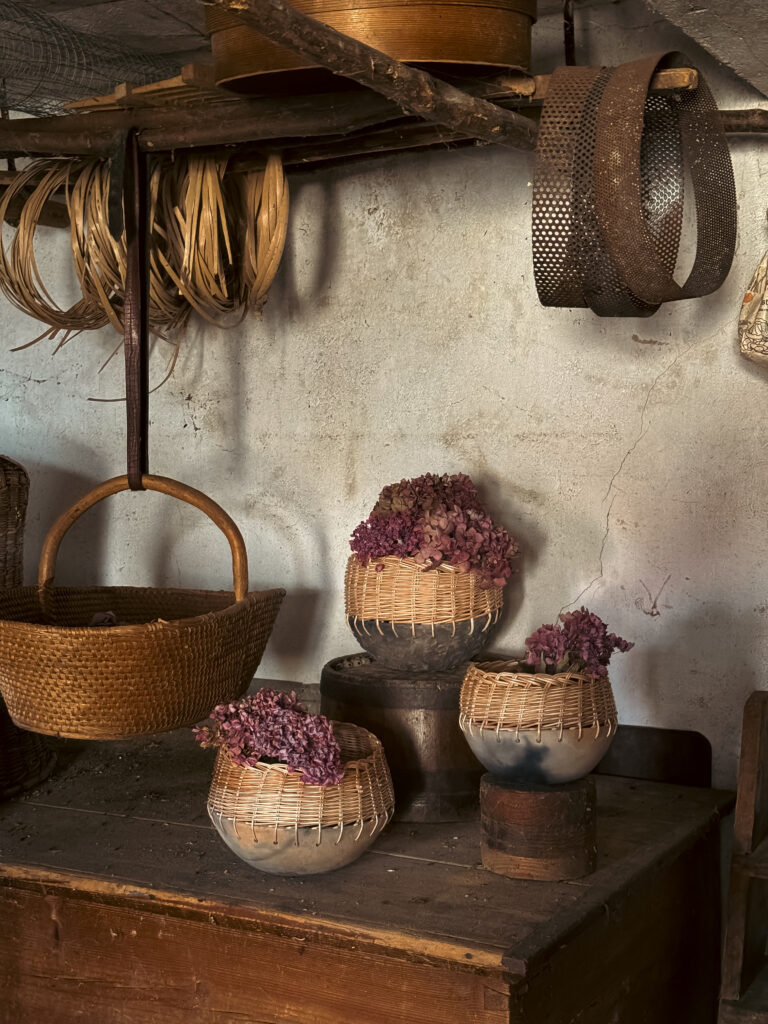
"Reverse Times" is a compelling series of three ceramic vases/bowls that intertwine the artist's personal heritage with sustainable practices. Drawing inspiration from the artist's grandfather, a basket weaver, these pieces incorporate willow branches from the same trees he once used, merging family history with art. Crafted from locally sourced Slovenian clay, known for its use in traditional ceramics, the vases are a nod to the country's artisanal legacy. The artist enhances the clay with homemade grog from recycled ceramics and construction waste, like roof tiles and bricks, showcasing a commitment to environmental mindfulness. Embracing ancient techniques, the ceramics are pit fired using waste materials from local carpentry, reducing energy use and connecting to historical firing methods. "Reverse Times" reflects a deep respect for tradition while addressing contemporary concerns of sustainability and ecological responsibility.
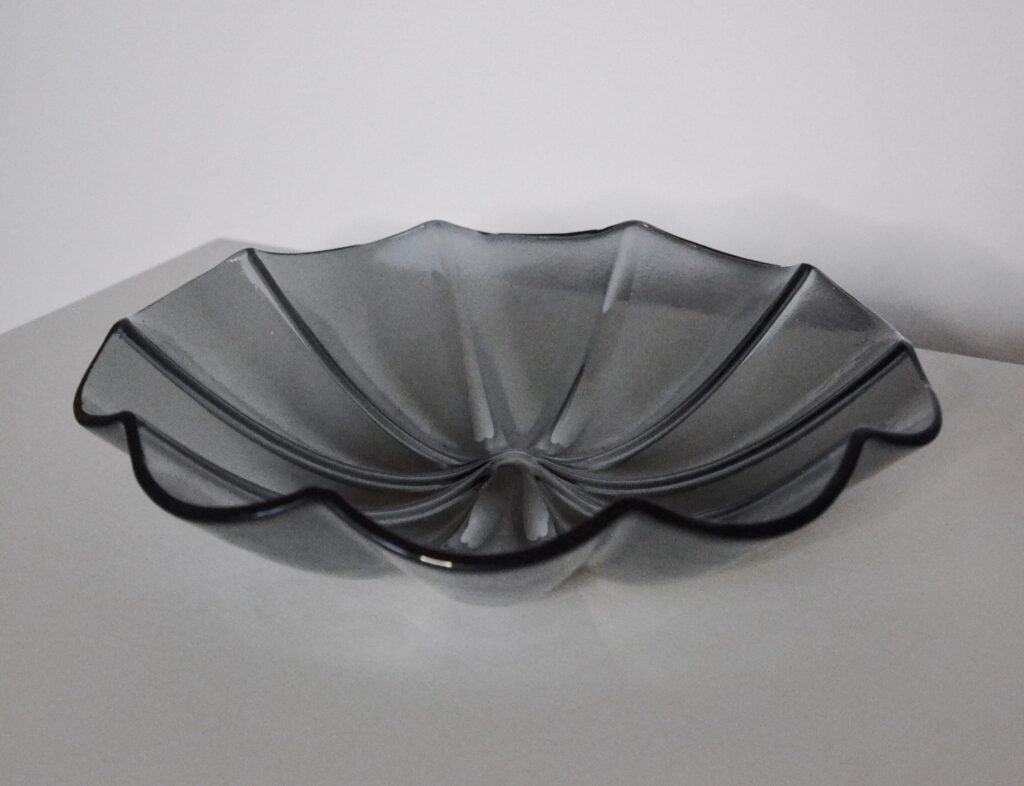
Res Vertere is a glass plate crafted from recycled glass collected from waste containers at a Ljubljana glassworks. This choice of material is more than a sustainable gesture; it's a profound symbolic transformation. Something once discarded, overlooked, and forgotten is given new life, becoming a vessel for meaning. The material, once deemed worthless, has undergone a metamorphosis in both form and significance. This piece invites contemplation on individual perception, and the beauty found in renewal. My glass plate embodies the intricate dance of individual perspectives, all stemming from a shared core. Its undulating form mirrors the constant flow of thoughts, experiences, and emotions coexisting in one space. Glass, as a medium, allows light to pass and refract, symbolizing how reality, though never perceived identically, is nonetheless shared. This plate isn't merely an object, it's a platform for collective experience, a reflective surface of our coexistence. The plate challenges conventional utility, having no "right" or "wrong" way to be used. This inherent openness is an artistic statement in itself: realities are not static; they exist in transitions, turns, and reversals. The reversibility of the object speaks to its fluid identity.
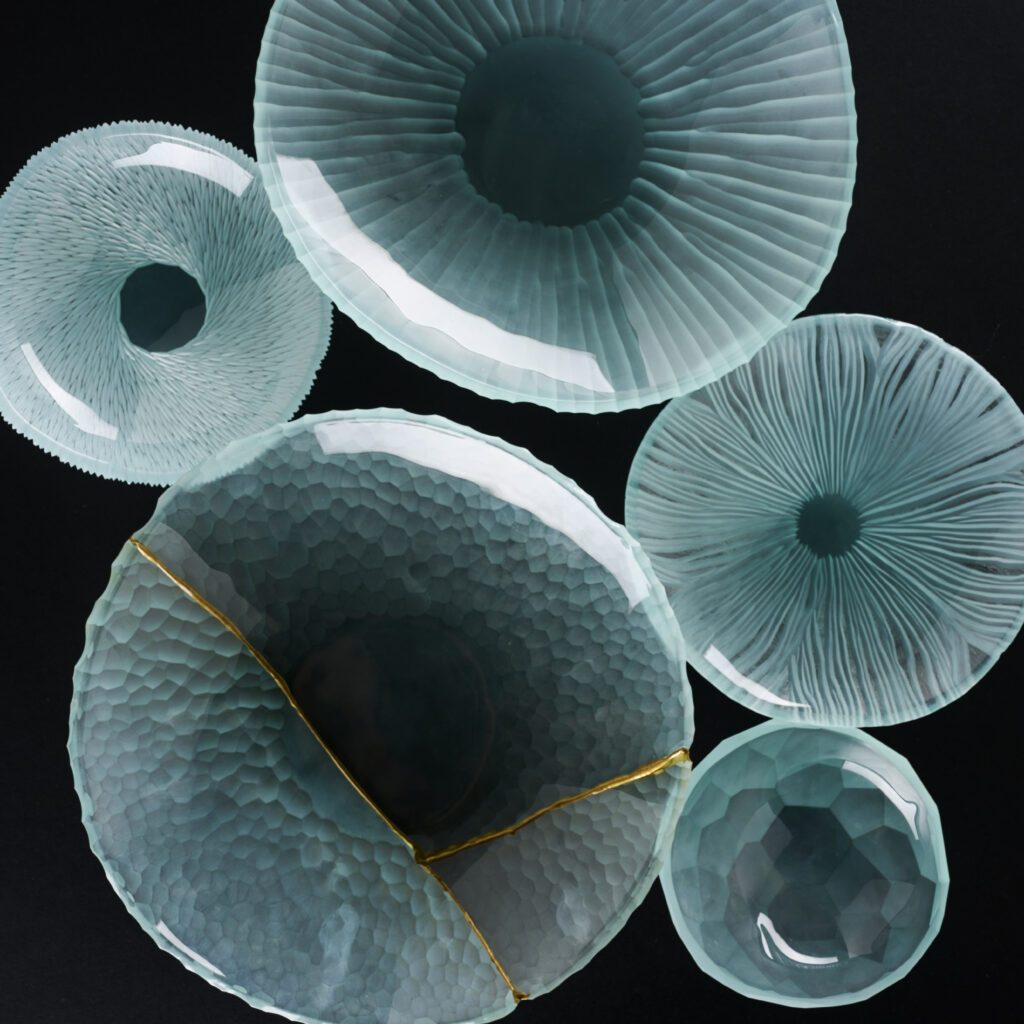
Resilienta is a set of five glass bowls that explores fragility and resilience. The bowls are made from recycled window glass, a material that once separated the interior from the outside world and now becomes the bearer of a new story. Through this transformation, I restore its value while reflecting on my own ability to adapt, regenerate, and persevere.
I cut the glass into circles and shaped them into simple bowls using the glass fusing technique. Unique patterns were created on their undersides through grinding. These are not deliberately designed ornaments, but rather traces of a long, repetitive process. They represent a dialogue between the hand, the machine, and the material. Each bowl carries its own texture, its own journey of creation, just as every individual carries their own experiences.
During the grinding process, the largest bowl cracked just before completion. This moment of fracture became central to my understanding of the work. Rather than discarding it, I repaired it using the Japanese technique of kintsugi. The golden seam does not conceal the crack but instead highlights it as a valuable part of the whole. The damage becomes visible, accepted, and integrated, much like scars. Rather than emphasizing weakness, it speaks of survival.
For me, Resilienta is a reflection on how we confront fractures, both material and personal. The work speaks of a gentle yet persistent strength, of embracing imperfection, and of the possibility that a new sense of wholeness can emerge from a crack.
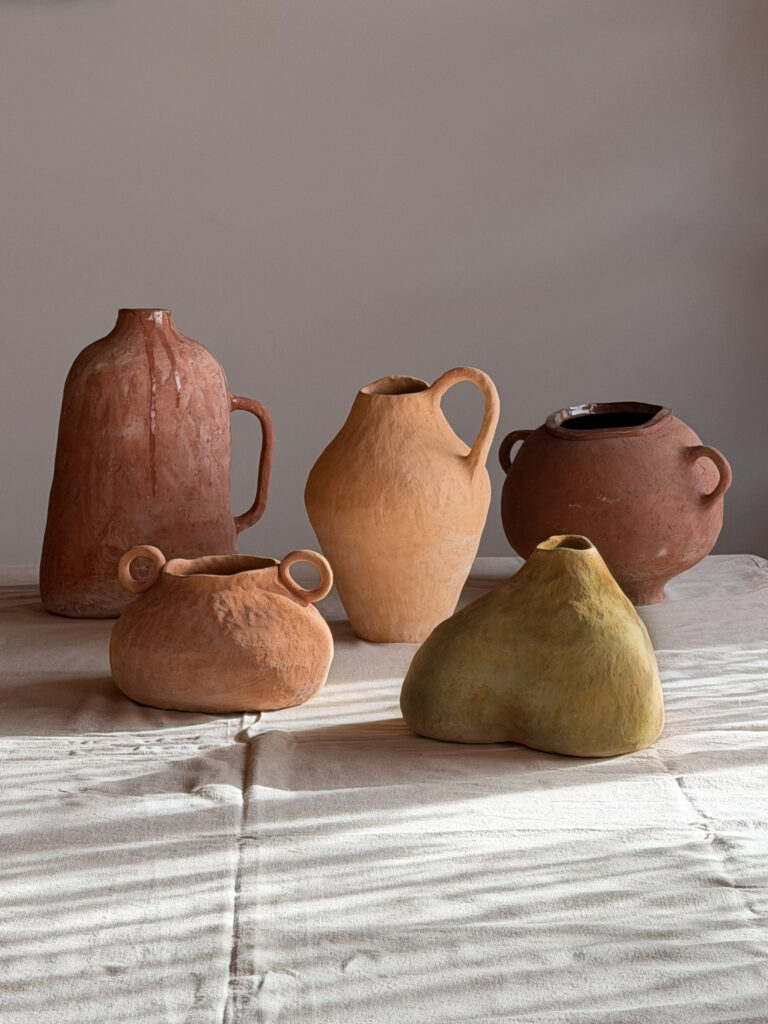
The series of vases was created using wild clay collected in the immediate surroundings of my family farm in Posavje, Slovenia. All the clay used originates from the region where I was born and raised, grounding the work in a specific place, its geology, and its landscape. Here, earth is not an abstract material, but a carrier of personal history and everyday connection.
Before shaping the objects, I systematically test each type of clay. I create test samples, firing them at different temperatures while observing changes in colour, shrinkage, strength, and porosity. These tests are not intended to identify the ideal material, but rather to understand the differences and limitations of each clay. Based on this research, I select the most suitable clays from which I then form the vases.
To improve the mechanical stability of the clay, particularly in larger objects, I add grog. I produce this myself by crushing failed and discarded ceramic pieces generated during the creative process in my studio. Ceramics is a medium in which unsuccessful attempts are an inherent part of the process, so recycled material is reintroduced as an active component of a new object. In this way, the work also reflects on material cycles, failure, and reuse.
The forms of the vases are not predetermined. They emerge intuitively through an ongoing dialogue with the material and its properties during the making process. Different clays respond differently to pressure, kneading, and hand-building. Some are more plastic and allow greater freedom, while others are more rigid and require adaptation. The resulting forms are therefore shaped by continuous decision-making, material limitations, and the physical relationship between my body and the clay.
The title The Earth That Shapes Me originates from my personal connection to the place where I was born and raised. This is the earth that has shaped me both as a person and as an artist. It is the place from which I draw my greatest inspiration, sense of belonging, and inner peace. The work is not merely a presentation of the material properties of local clay, but a reflection on the relationship between place, body, and the creative process. Here, the earth shapes not only the objects, but also me.