
Estela Ribeiro de Melo / Ovelha Mãe
- City
- Aveiro
- Country
- Portugal
Estela Ribeiro de Melo
Textile Artist · Craftsperson · Creative Director | Ovelha Mãe
Coimbra / Aveiro, Portugal · ovelha.mae@sapo.pt · Ovelha Mãe
PROFILE
Portuguese textile artist, craftsperson and Creative Director of Ovelha Mãe, a project created in 2010, with more than 20 years of
experience in textile craft. Her practice is rooted in Portuguese sheep wool, traditional textile knowledge and contemporary design,
combining hand spinning, weaving, natural dyeing, wet and needle felting, sewing and textile construction. She works with wool from
her own small flock and from nearby small producers, following the material from raw fleece to finished object. Her work explores
sustainability, circularity, local resources, heritage and new forms of textile expression.
EDUCATION & SPECIALISED TRAINING
• CEARTE – Textile Artisan Training, Portugal (from 2001).
• Specialised training in spinning animal, plant and cellulosic fibres with Sue Pearl (UK).
• Feltmaking with Nicola Brown (Ireland) and Irina Andreeva (Russia).
• Natural dyeing with Guida Fonseca, Lala de Dios and Michel Garcia.
• Eco-printing with Terriea Kwong (Hong Kong).
• Hand weaving with D. Salomé, Guida Fonseca, Lala de Dios, Chonin Ruesga and Soledad Santisteban.
• Batik training in Thailand.
PRACTICE & TECHNIQUES
• Hand spinning · natural dyeing · hand weaving · wet felting · needle felting · sewing and textile finishing.
• Portuguese sheep wool processing, from washing and preparation to spinning, dyeing and making.
• Traditional textile techniques combined with contemporary design, sustainable and circular approaches, reuse and low-waste
production.
• Development of textile objects, garments, accessories, installations, lighting and collaborative educational projects.
• Experience combining textiles with technology and interdisciplinary STEAM projects.
SELECTED EXHIBITIONS, RESIDENCIES & INTERNATIONAL PROJECTS
• CONTEXTILE 2026 – International Contemporary Textile Art Biennial, Portugal (2026).
• TEXTILFEST, Barcelona.
• Culture Moves Europe – international mobility/residency projects.
• Carpet Twist – international textile project.
• Residency in Seville (2019), followed by exhibitions in Portugal, Spain and Morocco.
• Portugal at Kokand, Uzbekistan – international craft/textile presentation.
• Iberia – Code 41 Trending Day / Seville Fashion Week (2020).
• European Museum Night projects (2025).
• FIA – Feira Internacional de Artesanato, Lisbon.
• Lisboa Design Show and Pavilhão de Portugal.
• International and national workshops, demonstrations, talks and educational collaborations.
COLLABORATIONS & PROFESSIONAL EXPERIENCE
• Founder and Creative Director, Ovelha Mãe (since 2010).
• Textile trainer and coordinator of craft training courses in Portugal.
• Collaborations with Portuguese designers, cultural institutions, schools and community groups.
• Creation of textile and craft artefacts for theatre and film.
• Educational projects connecting wool, felting, weaving, electronics, LEDs, solar energy and digital/STEAM learning.
• Work with children, students, older adults and communities through co-creation projects.
• Historical and contemporary demonstrations of the wool cycle and Portuguese textile heritage in Portugal and abroad.
AWARDS & RECOGNITION
• Honourable Mention – 1st Artes & Ofícios | Novo Design Award, promoted by Spira (2026), for “Nuvem”, a textile lamp made from
wool from her own sheep.
• Selected exhibitor – CONTEXTILE 2026, International Contemporary Textile Art Biennial.
SELECTED WORKS
• Nuvem – solar textile lamp in felted wool from own sheep.
• Other Skin – textile/fashion works exploring wool as a second skin.
• Iberia – collection of 11 outfits in felted sheep wool and linen, inspired by Portuguese and Hispano-Arabic tile references.
• Capucha – contemporary textile works inspired by traditional Portuguese mountain women’s capes.
• Teto de Presença – large-scale suspended handwoven installation in Bordaleira wool.
• Interactive wool and textile projects combining craft with electronics and environmental themes.
APPROACH
• Local wool · Portuguese textile heritage · sustainability · circularity · contemporary craft · experimentation · education ·
collaboration.
Artworks
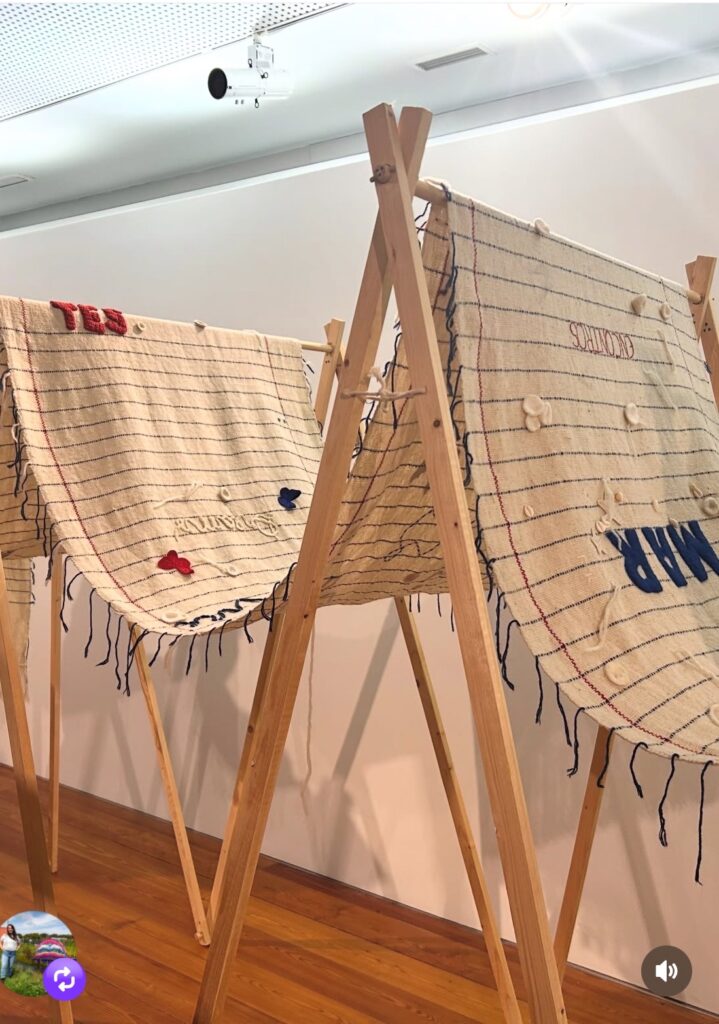
Teto de Presença is a large-scale suspended textile installation, handwoven from Portuguese Bordaleira sheep wool. Measuring approximately 2 × 1.1 × 6.5 metres, the work explores presence, territory and the fragile boundaries between the natural and the built environment. Paper leaves are incorporated into the textile structure, creating a delicate contrast with the strength and weight of the wool. Developed through a collaborative process with two Brazilian artists, the installation suggests an unstable, shifting landscape suspended between materiality and impermanence.
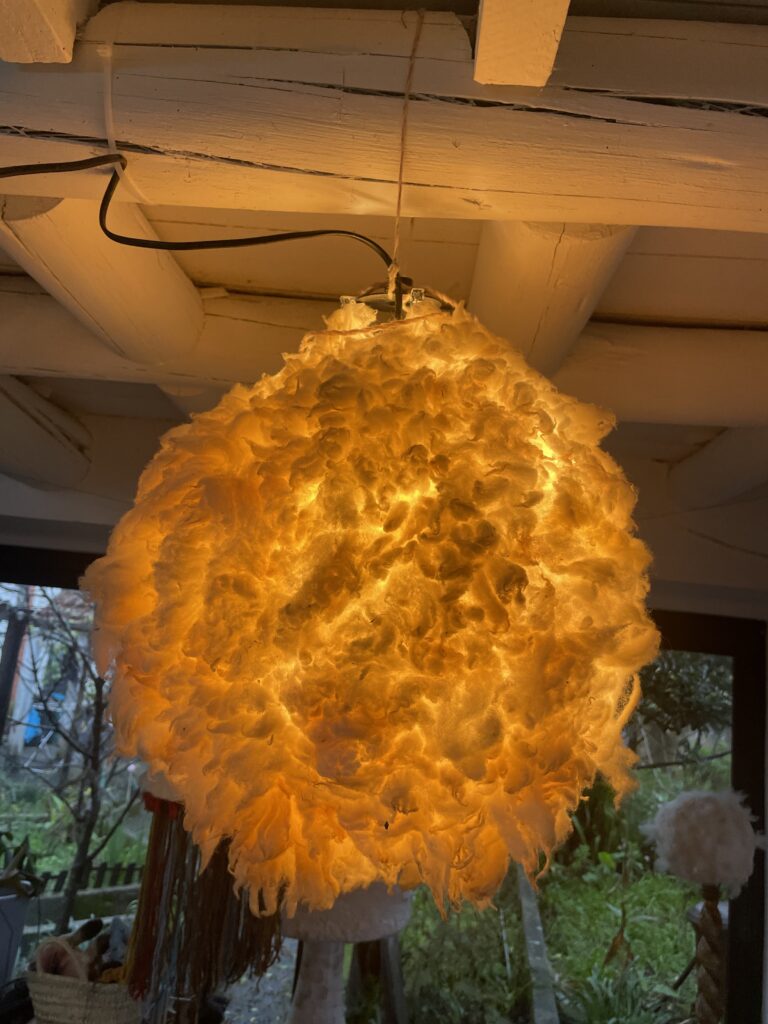
Nuvem is a handmade textile lamp created from wool from my own Portuguese sheep. The wool is wet-felted using only water and soap, transforming the raw fibre into a light, organic form that softly diffuses the light. Inspired by the simplicity and lightness of a cloud, the piece explores the relationship between natural materials, craft and contemporary design. Its simplicity is also a statement of sustainability, keeping the material close to its origin and giving local wool a new life as a functional design object.
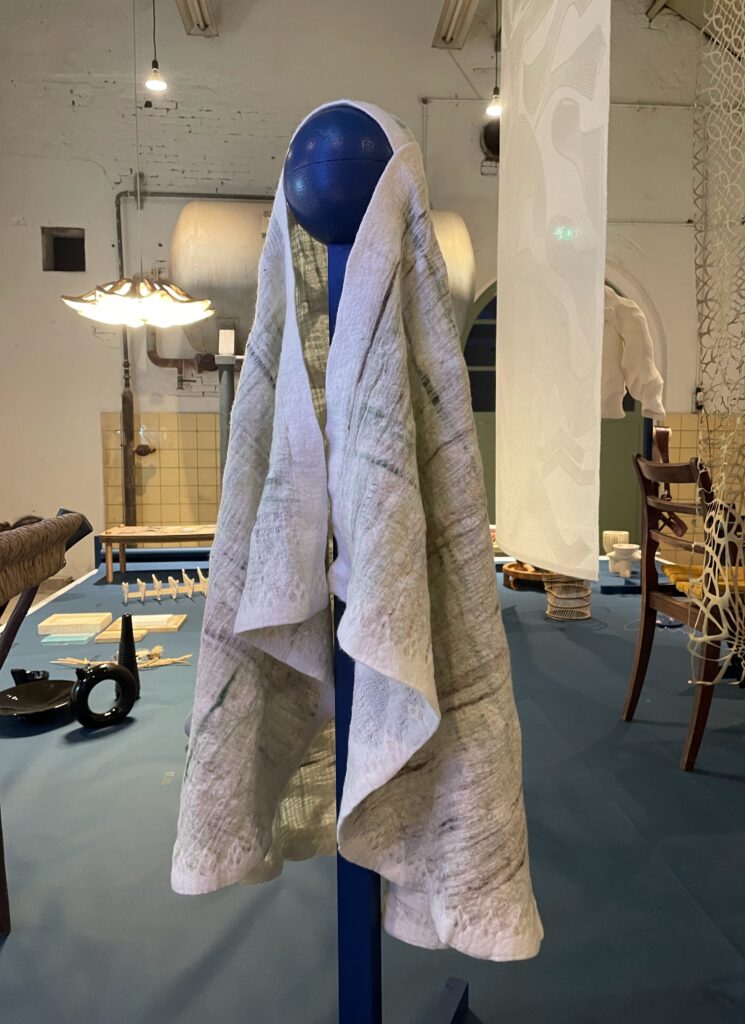
Capucha is a contemporary textile piece inspired by the traditional capuchas worn by women in the Portuguese mountain regions. Made from felted wool from Serra sheep, its white colour evokes the snow and harsh winter conditions endured by these women. The piece explores the contrast between apparent fragility and strength: fine, delicate and light in appearance, yet remarkably resistant, reflecting the resilience of the women who inspired it.
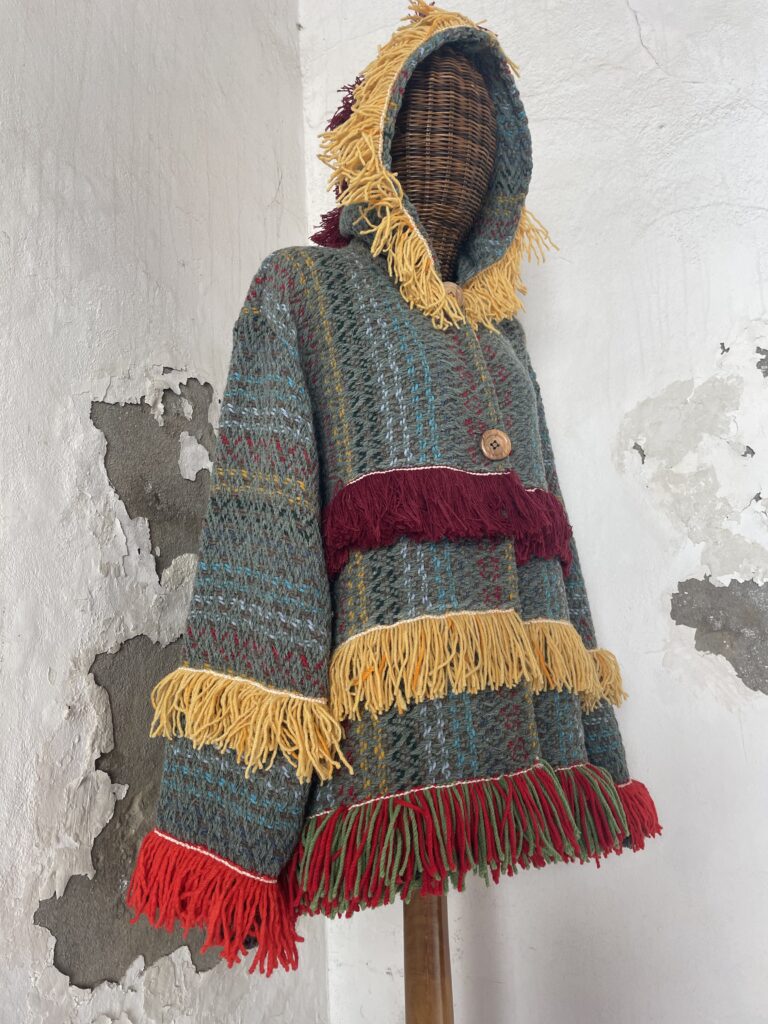
The Careto Coat is a contemporary textile piece inspired by the traditional Caretos de Podence, iconic figures of Portuguese winter festivities. Combining references to this cultural heritage with traditional wool craftsmanship, the coat reinterprets the expressive character and visual identity of the Caretos through contemporary design. It celebrates Portuguese intangible cultural heritage while exploring the potential of local wool as a material for contemporary fashion.