
Anita Lilic
- Country
- Spain
Anita Lilic is a Serbian artist based in Spain. She holds a BA in Scenography and an MA in Artistic Practice from UPV, Valencia. Her work involves sculpture, hybrid objects, and installation, with a focus on textiles. She explores camouflage in urban environments, memory of objects and uses discarded materials to address the contact between humans and nature. Her practice centers on material experimentation and site-specific work.
I have worked with textiles for a long time, starting from my studies in textile design in high school. My practice has since expanded to clay and other materials, centering on experimentation and hybrid forms. I focus on manipulating discarded textiles and organic materials to create objects and installations that investigate the boundaries between the human and the natural.
I am interested in combining techniques such as weaving and fabric layering with reclaimed materials, exploring the artistic and narrative potential of crafts in both their traditional sense and adapted to local and present structures.
Artworks
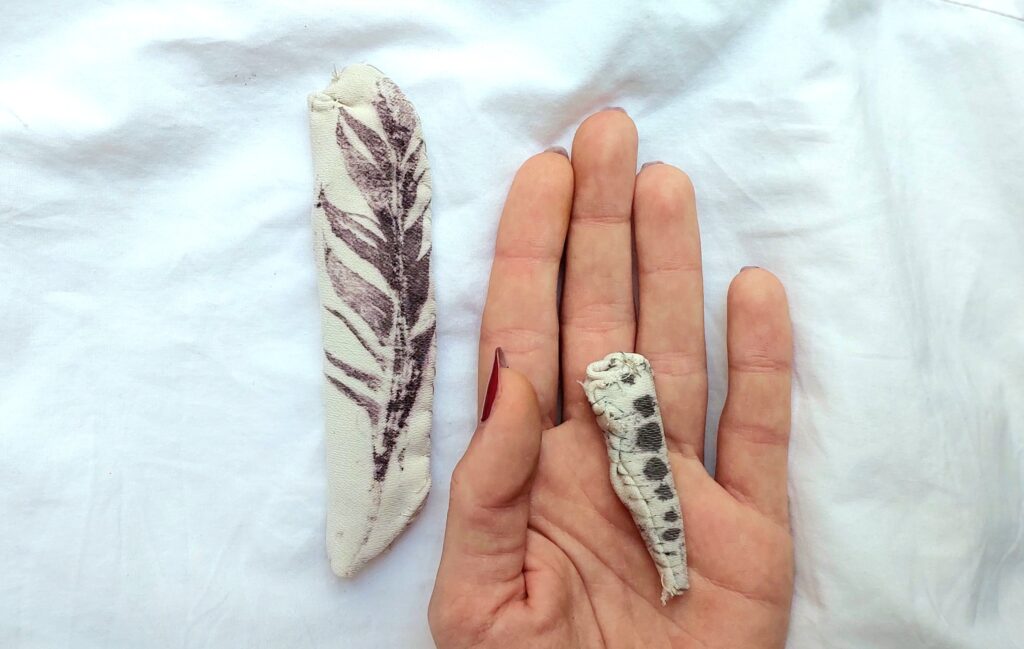
Natural objects are reduced to their traces, reflecting on the limits of sight and touch, and evoking fossils that connect memory and materiality. Discarded textiles reveal contemporary camouflage as a way of inhabiting the landscape. Earth is collected from the places where the objects were found, and together with pigments, their textures are transferred onto the discarded textiles. The objects are then sewn into their own "skins."
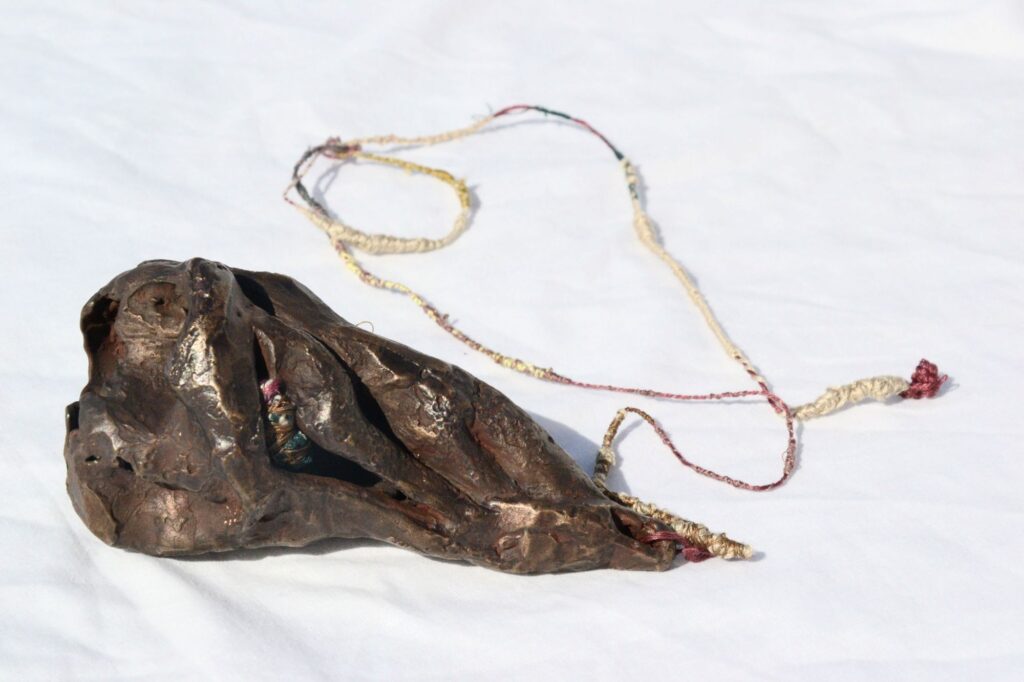
Objects, from their creation to their decomposition, exist in a state of transformation.A bronze-cast sculpture evokes a hybrid form between stone and structures created by animals and insects. In this context, the stone—symbolizing strength and barrier—becomes a protective skin.The anthropomorphic emerges through the exploration of boundaries between what is shaped by natural processes and what is altered by human intervention, using textiles as a medium.
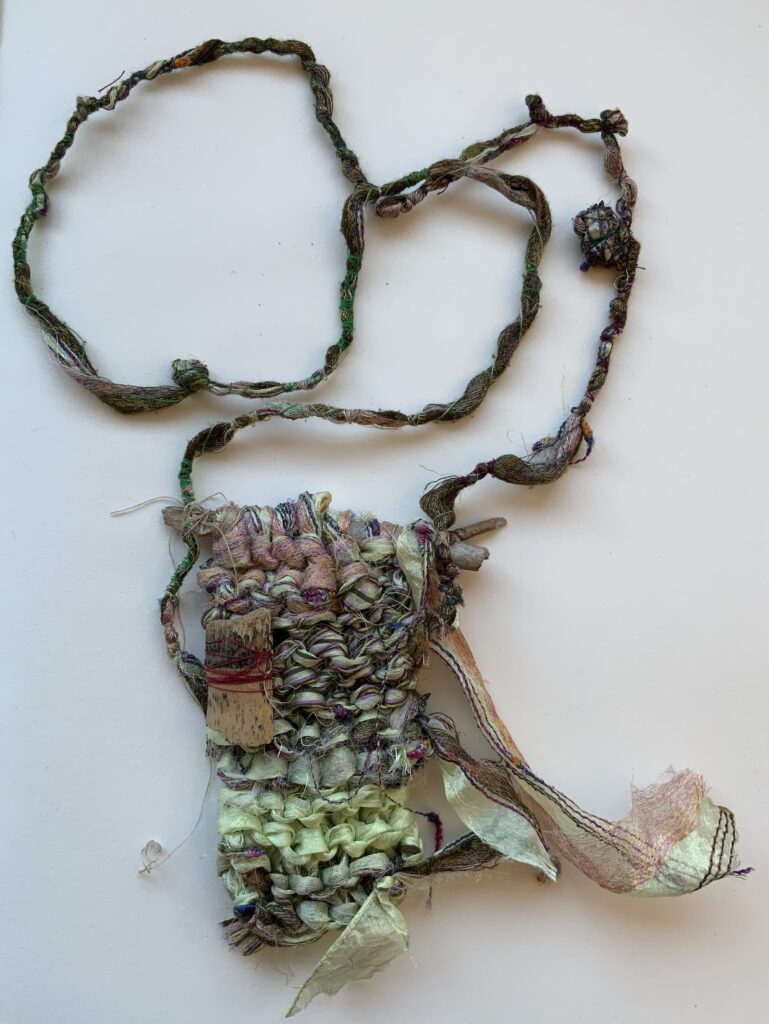
The coexistence of nature and waste in the construction of our surroundings is addressed through the creation of hybrid objects that resemble amulets. These are made from collected materials and discarded textiles, using textile techniques such as weaving and crochet. From the perspective of contemporary animism, objects are understood as active participants that communicate, influence, and shape both the territory and our perception of it, as well as society. They function as material traces of processes and habits, revealing fragments of inhabited space and generating connections between the physical and the sensitive.
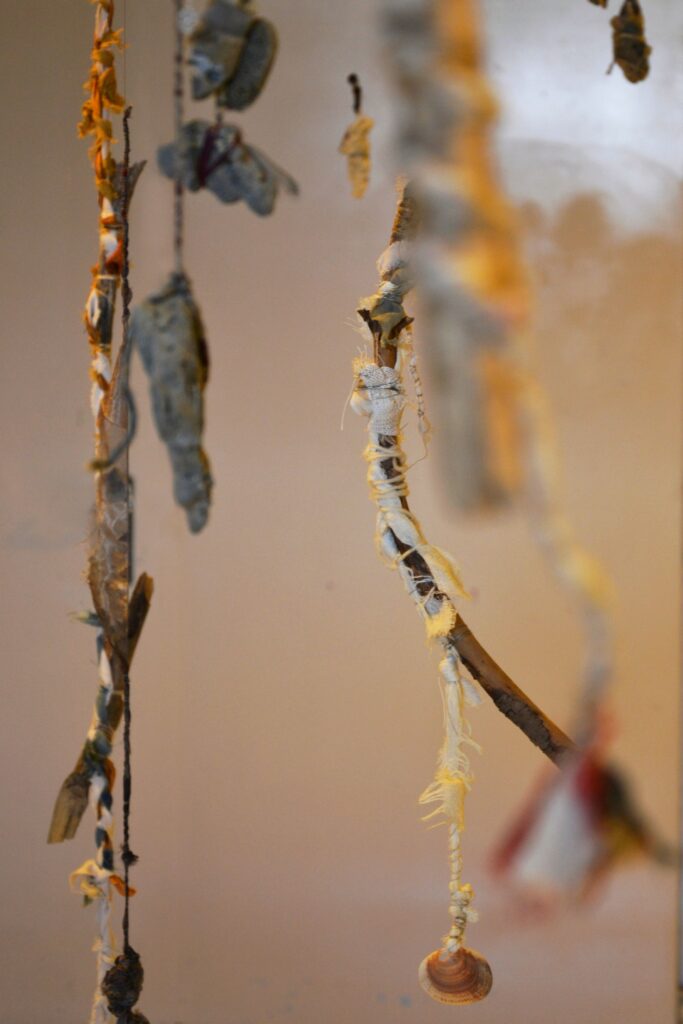
The coexistence of nature and waste in the construction of our surroundings is addressed through the creation of hybrid objects that resemble amulets. These are made from collected materials and discarded textiles, using textile techniques such as weaving and crochet. From the perspective of contemporary animism, objects are understood as active participants that communicate, influence, and shape both the territory and our perception of it, as well as society. They function as material traces of processes and habits, revealing fragments of inhabited space and generating connections between the physical and the sensitive.